
Old and informal ones did not.
On Friday 9 October 2026 at 12:56, the Azuero peninsula experienced the strongest earthquake ever recorded in Panama. There were no deaths, and the skyscrapers and Canal bridges performed well. But more than a thousand homes, hundreds of schools, centuries-old churches, hotels, bridges and roads were damaged, and several communities were cut off.
At ISOThermal we compiled the available public data into an independent 18-page analysis (Spanish and English) and nine infographics. This article summarises the essentials: what happened, why, and what to do so that the next earthquake finds the country better prepared — including small homes and self-built housing.
*Preliminary SINAPROC figures (Bulletin No. 7, 11 Oct 2026).
The earthquake
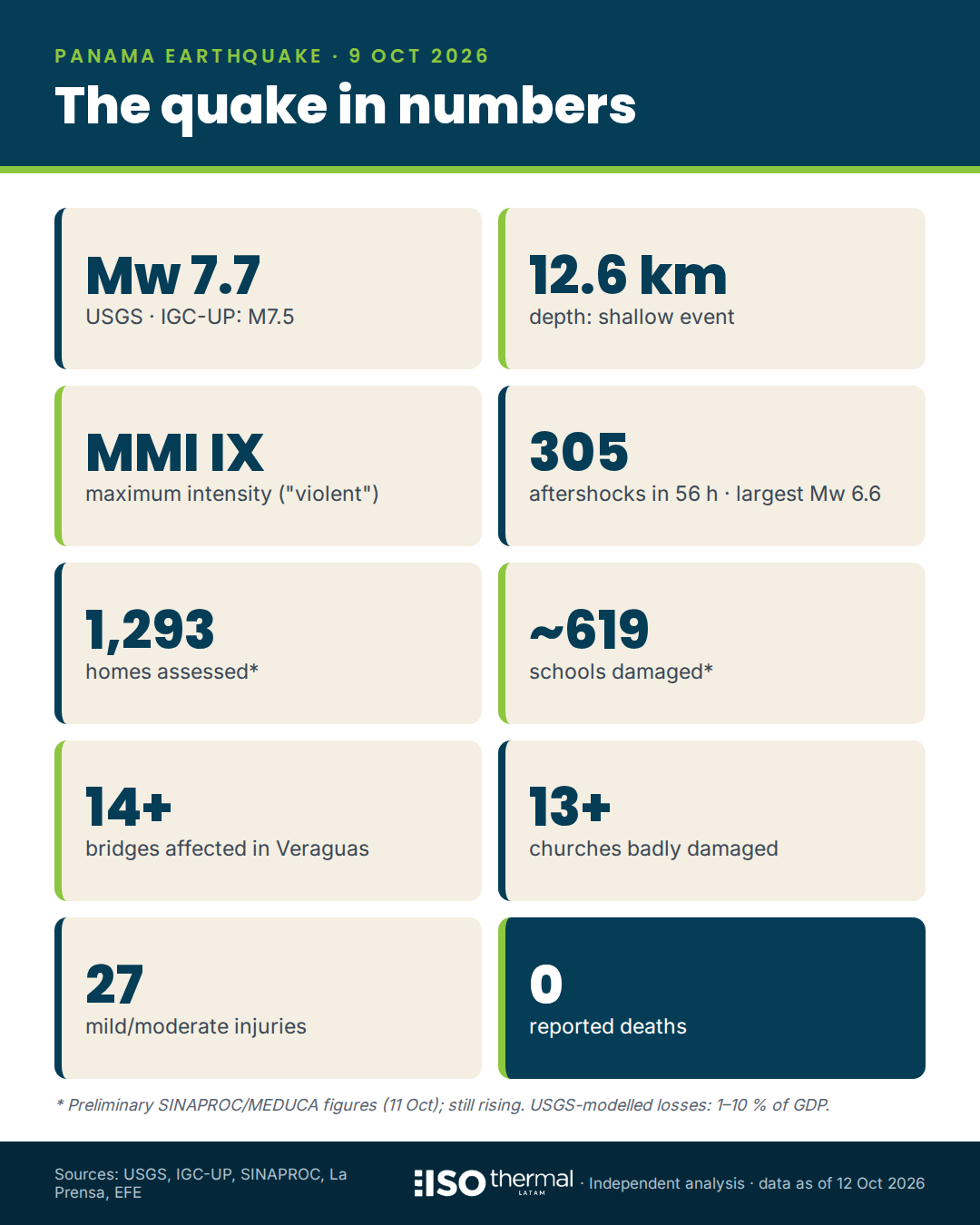
- Magnitude: Mw 7.7 according to the USGS (preliminary 8.0 → 7.6 → 7.7) and M7.5 according to the University of Panama's Geosciences Institute (preliminary 7.2). Each agency uses different networks and methods.
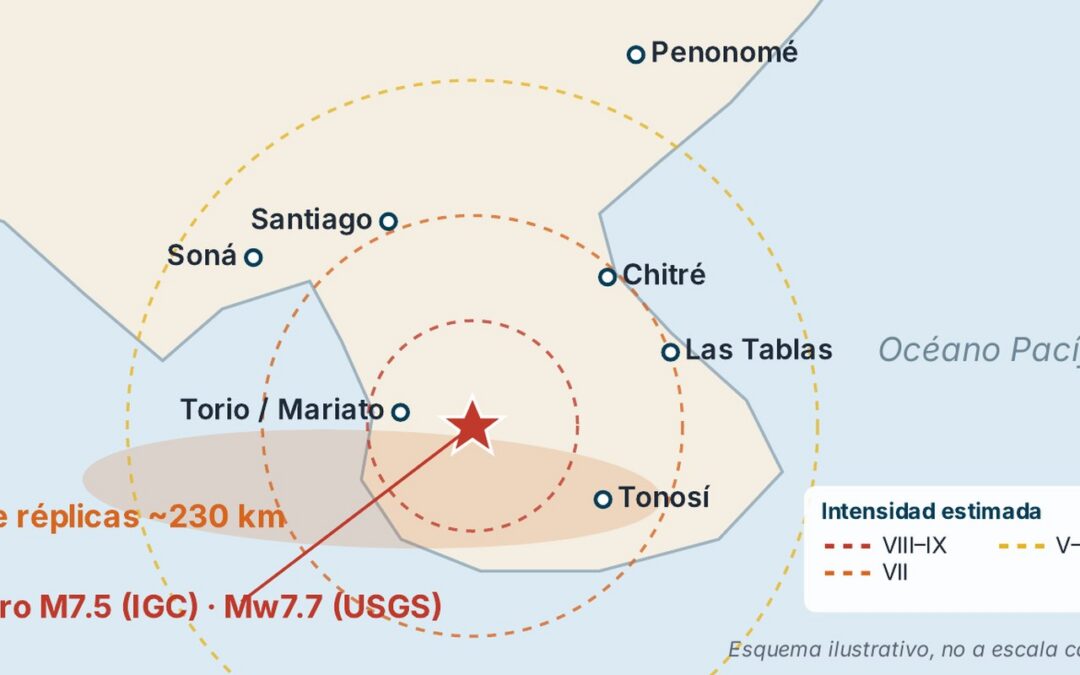
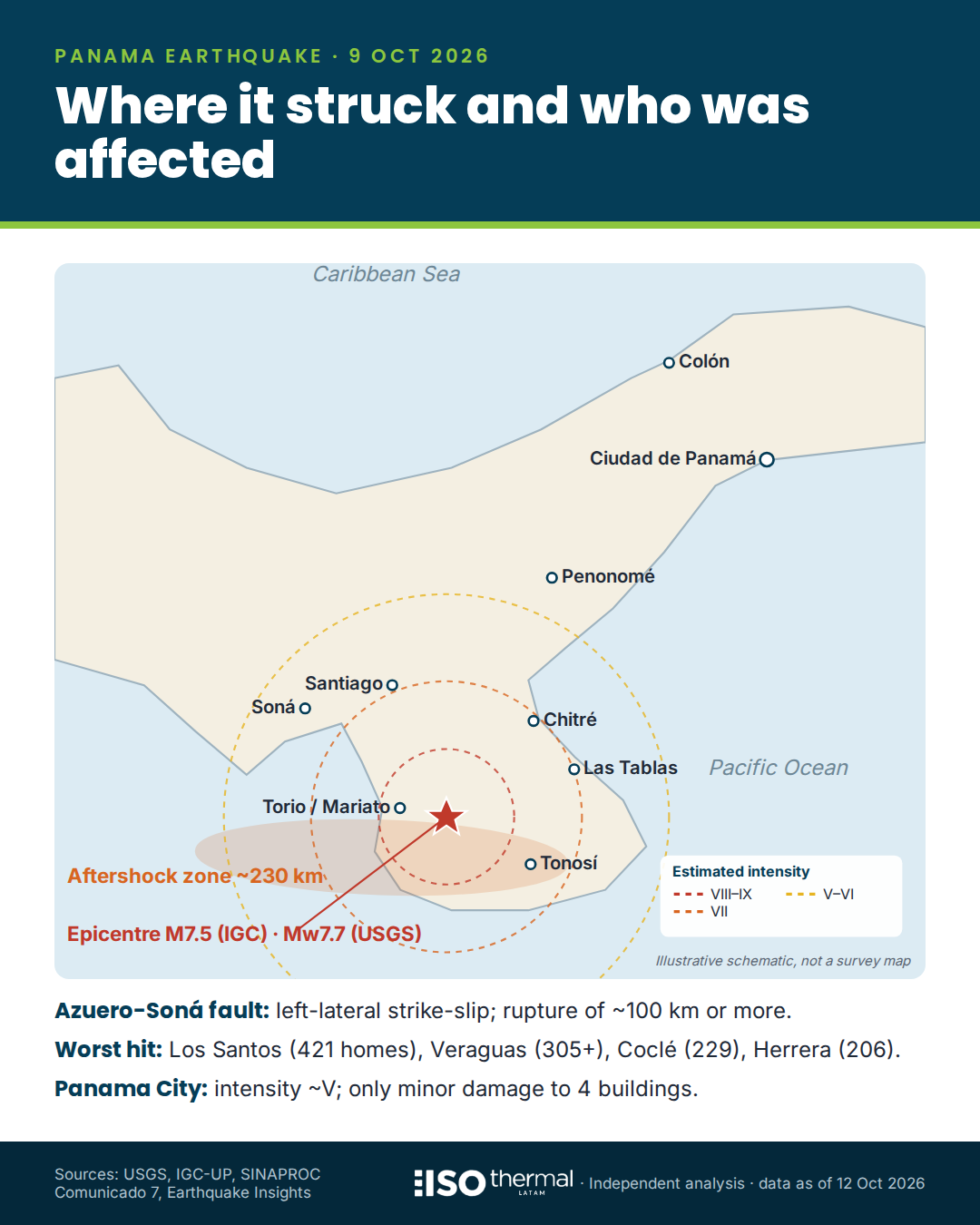
- Epicentre: about 39 km west of Tonosí, on the Azuero-Soná fault; a shallow earthquake (~12.6 km).
- Intensity: up to IX (violent) near the epicentre; about 194,000 people felt intensity VIII–IX.
- Aftershocks: 305 in 56 hours, four of them above M6 in the first 11 hours (the largest, Mw 6.6).
- What comes next: according to the USGS forecast, an M6+ aftershock within the next year is likely and there is about a 24% chance of an M7+ event. Damaged buildings should not be occupied until they are assessed.
A known risk
Panama is no stranger to earthquakes. The 1913 earthquake occurred on the same Azuero fault system and destroyed the tower of the Macaracas church; 113 years later, churches in the same region lost their towers again.
| Year | Zona | Magnitude | Impact |
|---|---|---|---|
| 1882 | Golfo de San Blas / Colón | ~7.9 | Tsunami in San Blas; damage to Panama's Cathedral and Cabildo; uncertain death toll |
| 1913 | Azuero (Tonosí) | 6.6–6.9 | Same fault system as 2026; destroyed the Macaracas church tower |
| 1934 | Puerto Armuelles | 7.4–7.7 | Damage to the pier and David; local tsunami |
| 1991 | Limón (CR) / Bocas del Toro | 7.6 | 23 dead and 559 injured in Panama; >5,500 displaced |
| 2003 | Puerto Armuelles | 6.5 | 2 dead; damage to roads and homes |
| 2026 | Azuero (Herrera / Los Santos) | 7.5 IGC · 7.7 USGS | Largest earthquake recorded in Panama; 0 deaths; >1,200 homes assessed |
Damage by province
Breakdown from SINAPROC Bulletin No. 7 (11 October, 12:00). The number of homes changed every day — 142 → 426 → 840 → 910 → 1,293 assessed — as teams reached isolated communities.
| Province | Homes | Schools | Health | Other |
|---|---|---|---|---|
| Los Santos | 421 | 35 | 4 | 5 hotels · 28 public bldgs · 1 bridge |
| Veraguas | 305+ | 192 | 8 | 3 churches · 9+ bridges · 9 road sections |
| Coclé | 229 | 32 | 2 | 6 hotels · 10 churches · 1 footbridge |
| Herrera | 206 | 91 | 3 | 5 churches · 4 road sections · 1 landslide |
| Chiriquí | 75 | 87 | 2 | 10 total losses · water tank collapsed |
| Panama | 4 PH | 43 | — | minor damage |
| Colón | 7 + 19 multifam. | 12 | 1 | municipal market · 1 bridge |
| Panamá Oeste | 21 | 18 | 3 | 3 churches |
| Bocas del Toro | 8 | 25 | — | |
| Darién | 1 | 15 | 1 | |
| Ngäbe-Buglé / Guna Yala | — | 21 / 9 | — | indigenous regions |
What worked and what failed
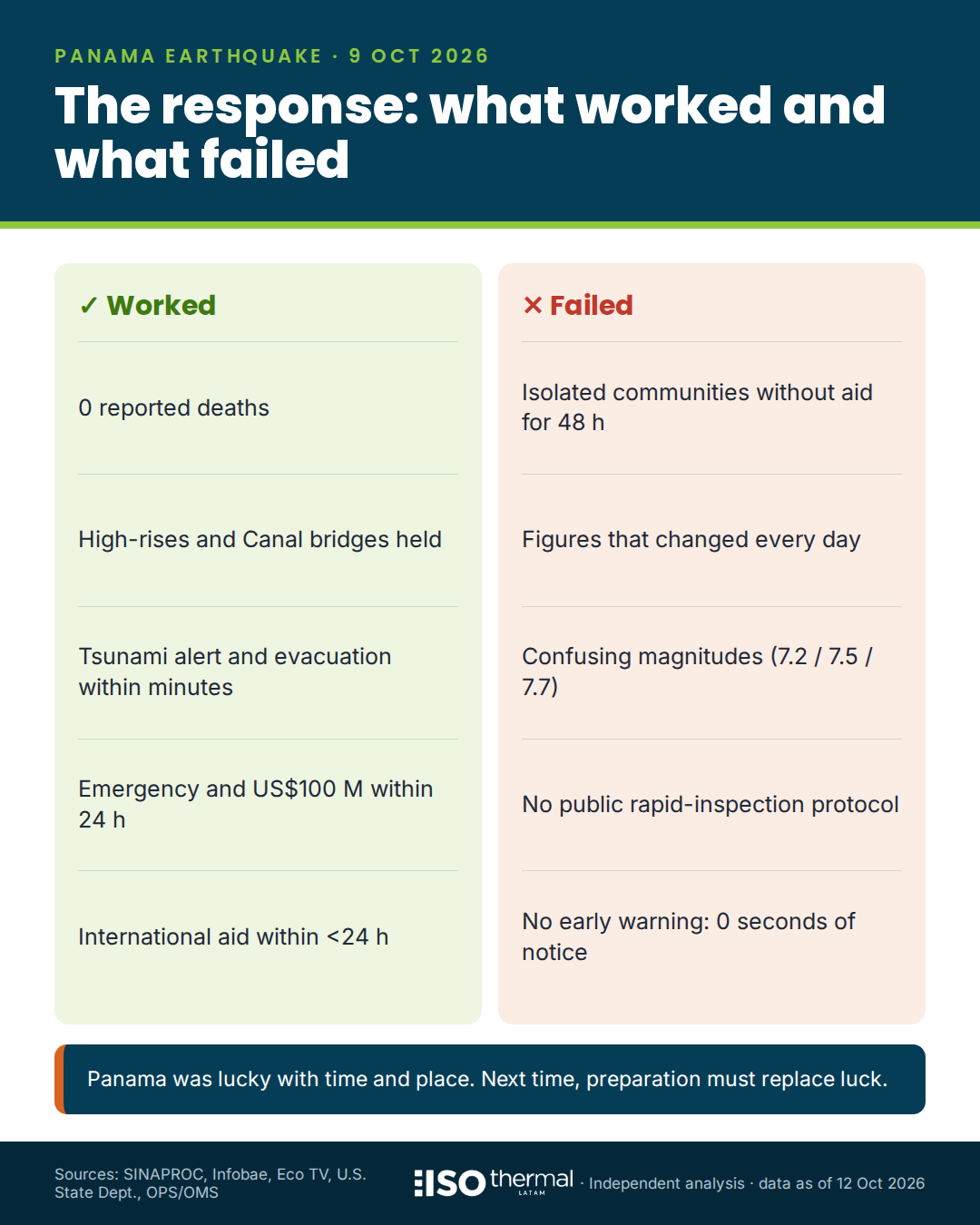
- Zero reported deaths.
- Skyscrapers and Canal bridges with no damage requiring closure.
- The Canal, the airport and economic activity kept or resumed operations.
- Tsunami alert and preventive evacuation within minutes.
- State of emergency and a US$100 million fund within 24 hours; fast international aid.
- The Geosciences Institute published daily aftershock reports.
- Isolated communities without aid for about 48 hours (Torio, Macaracas, Tonosí and others).
- Centralised distribution, with little role for municipalities.
- Different home and school counts between institutions and days.
- Confusing magnitude messages in the first hours (7.2 → 7.5 versus 7.7).
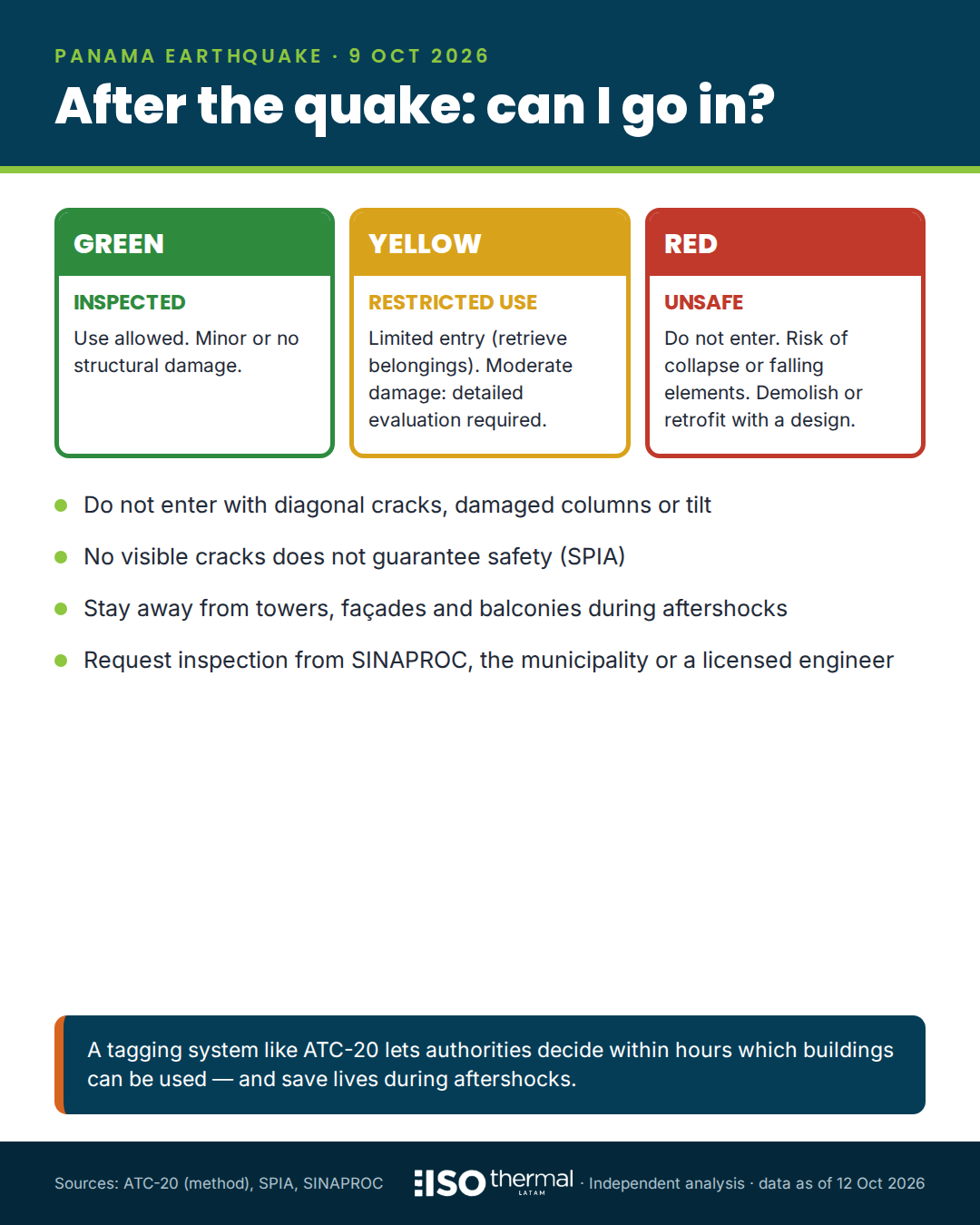
- No public rapid-inspection protocol (green/yellow/red tags).
- No early warning: people did not get a single second of notice.
Root causes
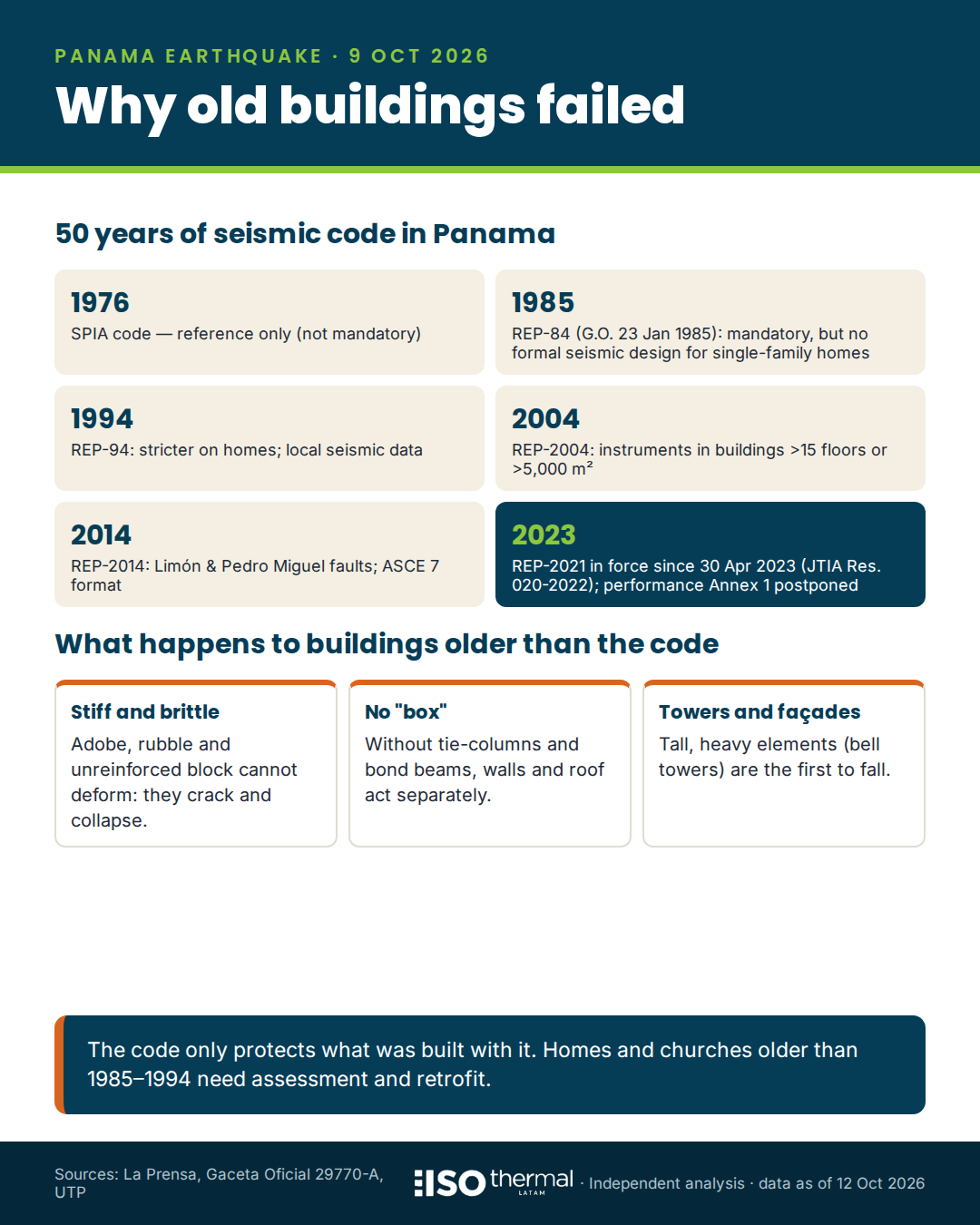
What was ignored
- Early warning: in June 2026 the Geosciences Institute called for an early-warning system (US$1.5–3 million); in August Panama was trying to enable Google's Android alert. By 9 October neither existed.
- Incomplete seismic network: of 63 seismographs, only 50 were active.
- Schools without maintenance: classrooms documented as "at risk" and school infrastructure projects stalled since 2013.
- Heritage without retrofitting: a restoration plan for historic sites in Los Santos and Herrera had been announced; there is no record of it being carried out before the earthquake.
- The 1913 precedent: same fault system, with no published recurrence study or regional plan.
Where public management fell short
- No construction code or site inspection: nobody systematically checks that what is built matches the design.
- Single-family homes off the radar: for decades houses were not required to have seismic design, and self-building still has no mandatory technical assistance.
- Schools, hospitals and public buildings without a seismic inventory or a funded retrofit programme.
- Heritage protected by law since 1938 without structural intervention.
- No vulnerability maps or microzonation to guide permits.
- Last mile: announcements and airlifts, but isolated communities without supplies for 48 hours.
- Data: each institution reported different figures; there was no single public dashboard.
- Science communication: different magnitudes without a clear explanation.
- Inspection: no public rapid-tagging protocol; reviews were postponed because of the aftershocks.
- Local governments with little role, despite knowing the territory best.
Action plan: 0–3, 3–18 and 18+ months
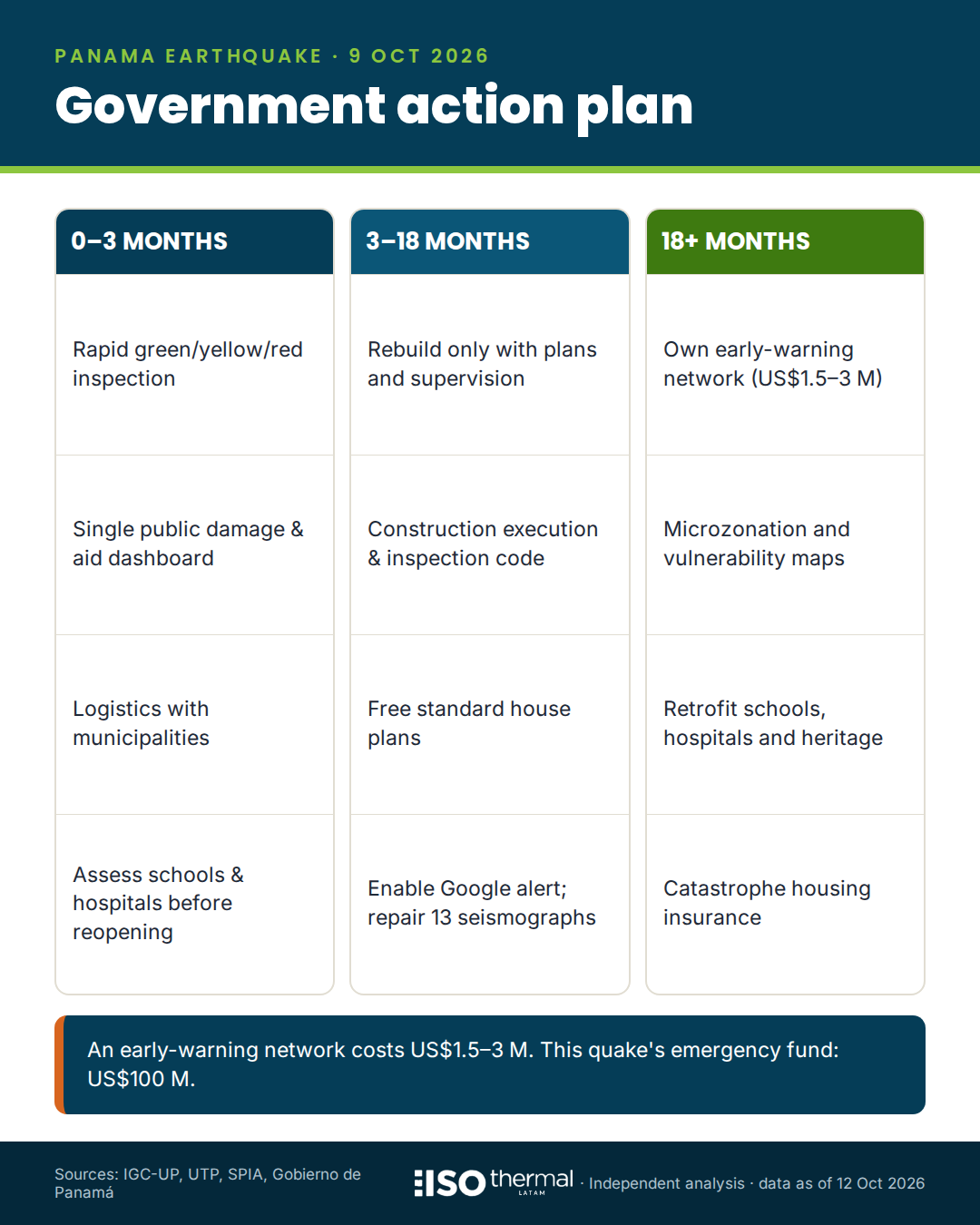
For homeowners and people building their own home
Most damage to homes in the interior follows the same pattern: block walls without tie-columns or bond beams. Well-built confined masonry is affordable and proven in Latin American earthquakes. The golden rule: every wall must be "framed" by reinforced concrete — a foundation beam below, columns at the ends and at the edges of doors and windows, and a bond beam on top, all connected like a box.
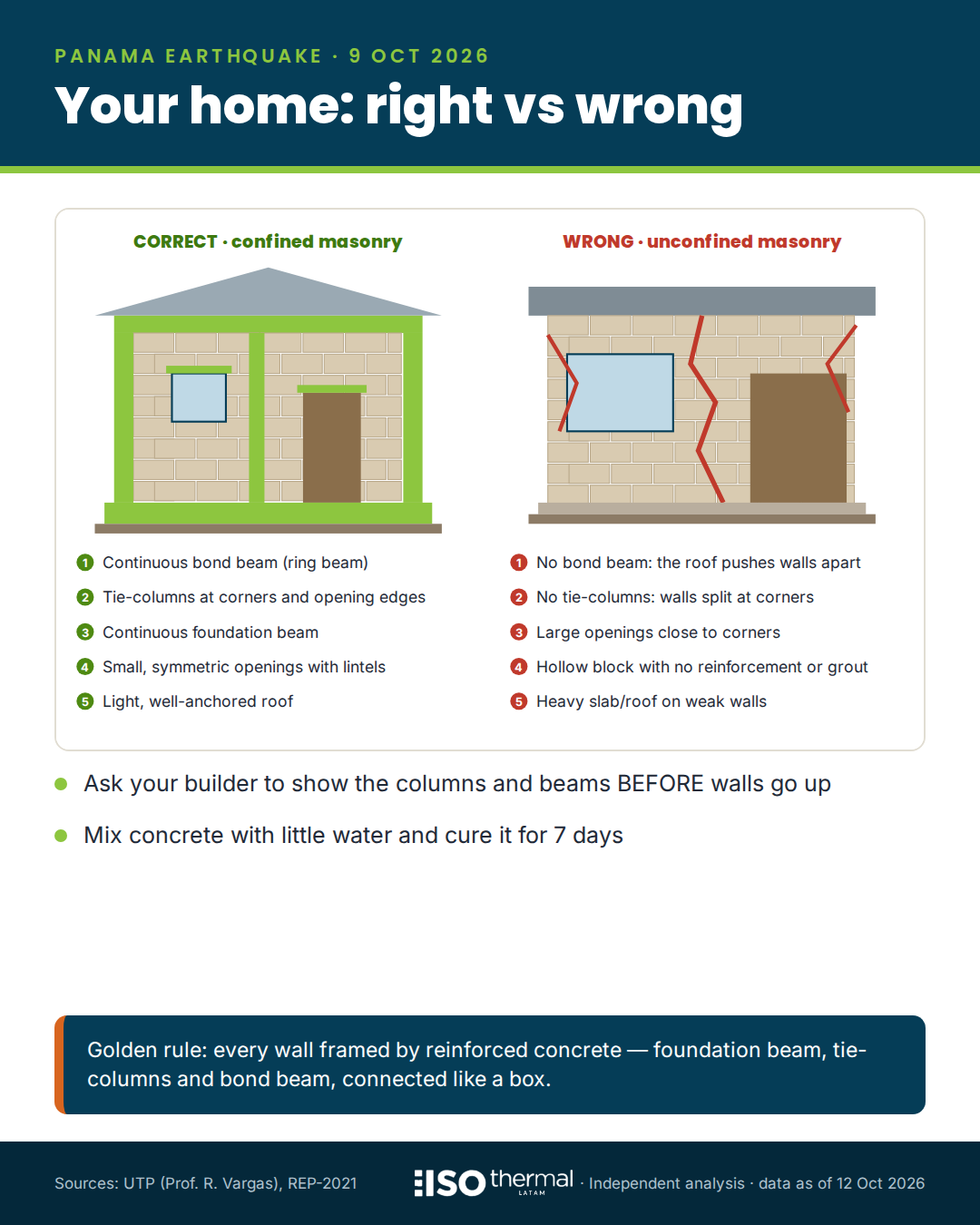
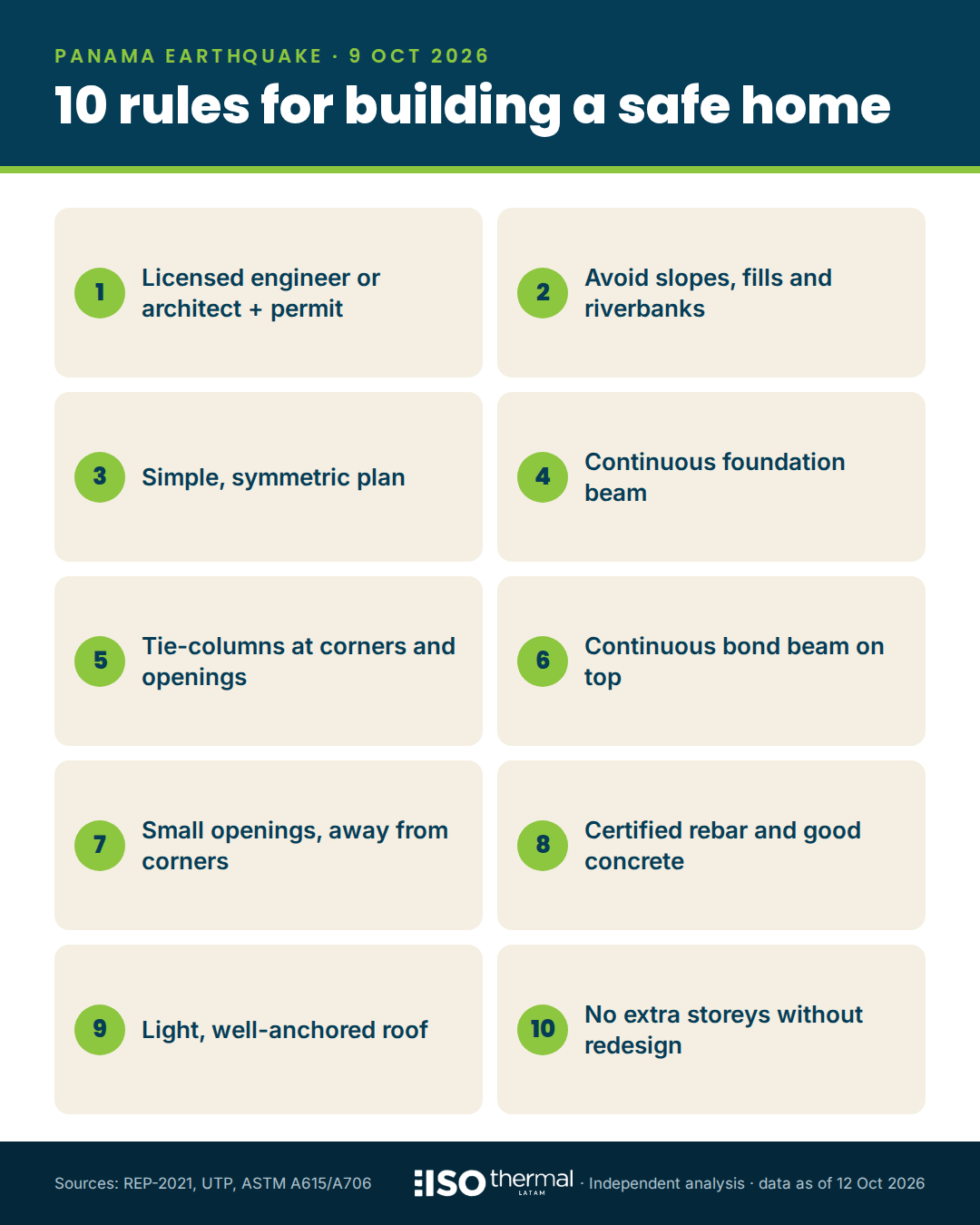
After the earthquake: inspection and slabs
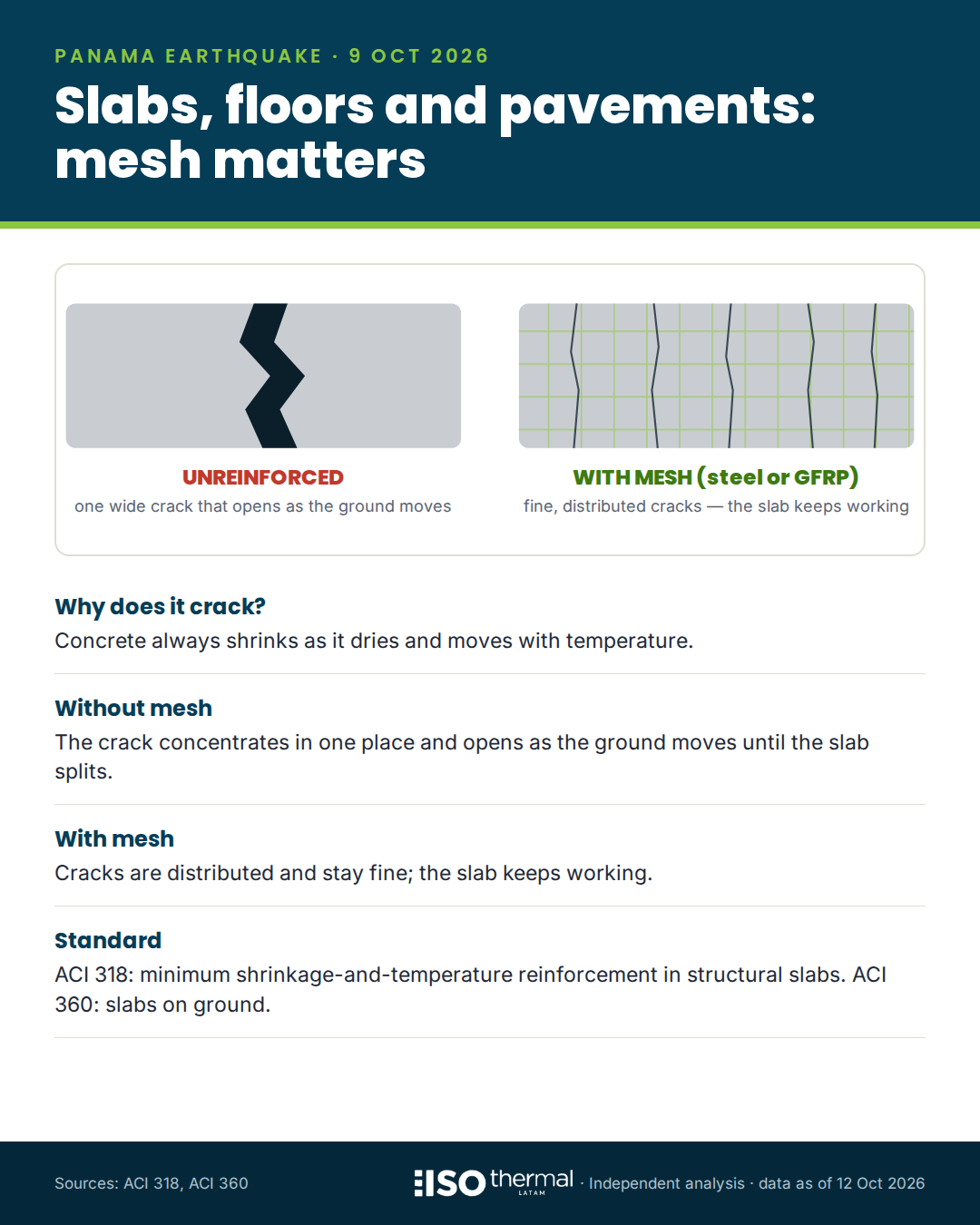
A diagonal crack in a wall, a gap between wall and column or a column with spalled concrete are signs to request an assessment before moving back in. And in slabs, floors and pavements, minimum shrinkage and temperature reinforcement stops a crack from turning into a fracture that splits the concrete.
Download the full analysis
The full 18-page report includes the response timeline, damage by sector, the guide for professionals, post-earthquake inspection and all 40 numbered sources.
Main sources
- USGS — M 7.7, 12 km WSW of Pitaloza Arriba, Panama (event us6000u18k / pt26282000)
- La Estrella de Panamá — Más de 300 réplicas registradas en Azuero (12 Oct 2026)
- Retén Chiriquí — SINAPROC Comunicado N.º 7: más de 1,200 viviendas y ~619 centros educativos (11 Oct 2026)
- Infobae — Damnificados bloquean una carretera mientras el Gobierno asegura que distribuye ayuda (11 Oct 2026)
- La Prensa — Terremoto en Panamá: lo que revela sobre la seguridad de los edificios
- La Prensa — El secreto de las edificaciones, las normas sísmicas y la falla de San Andrés
- La Prensa — MOP reporta daños en vías y al menos 14 puentes afectados en Veraguas
- Panamá América — La evaluación de las infraestructuras críticas es impostergable (UTP)
- La Gaceta de Panamá — Qué es la Falla Azuero-Soná
- Destino Panamá — Instituto de Geociencias urge sistema de alerta temprana (jun 2026)
- Universidad de Panamá — La Red Sísmica del IGC detectó 773 sismos
- TVN — Panamá aún no cuenta con un sistema de alerta temprana para terremotos
- La Prensa — Aulas en riesgo y escuelas en crisis: el abandono de la infraestructura educativa
- RPC Radio — Ministerio de Cultura planifica restaurar sitios históricos en Los Santos y Herrera
- La Estrella de Panamá — Estados Unidos estima impacto de hasta 10 % del PIB
- TVN — Panamá se blinda ante desastres: fondo especial e instrumentos contingentes
- OPS/OMS — Informe de situación 1: Terremoto en Panamá, octubre 2026
- U.S. Department of State — The United States Mobilizes Immediate Response to the Panama Earthquakes
- BID — Condiciones habitacionales y déficit de vivienda en la década de la construcción de Panamá
- Gaceta Oficial N.º 29770-A — REP-2021 (Res. JTIA 020-2022; vigencia 30 abr 2023)
Note: independent analysis by ISOThermal Innovations based on public information as of 12 October 2026. Figures are preliminary and may change. Names of institutions and media are cited for information purposes only. This content does not replace an assessment by a licensed engineer.
Contact
ISOThermal Innovations Inc.
📧 [email protected]
📲 WhatsApp: +507 6410-4364
🌐 isothermal.eco
 EN
 ES