
It dies from corrosion.
Price per bar is the wrong metric. Chlorides — deicing salt in Slovakia, Norway, or Canada; sea spray in Italy, Florida, or Panama — reach the reinforcing steel, rust takes up 4–6 times the volume of the original steel, and the concrete cracks and spalls. A deck designed for 100 years asks for its first major rehabilitation at 20–30. Modern infrastructure procurement no longer compares material prices: it compares three life-cycle metrics. And on all three, the result favors GFRP reinforcement.
The three metrics, on one page
The size of the problem: the economics of corrosion
| Scope | Measured cost | Source |
|---|---|---|
| US — all corrosion | US$276 billion/year (~3.1% of GDP) | NACE / FHWA, Congress-mandated study |
| US — bridges only | US$8.3 billion/year in repairs | NACE 2002 |
| US — deicing salt | ~US$3 billion/year; US$615 in damage per ton of salt | NACE / FHWA |
| Canada — all corrosion | C$51.9 billion/year | 2023 national study |
| Slovakia — 575 Class I bridges | €50 M/year per closed bridge → €28.75 billion | Slovak Ministry of Transport, 2025 |
Panama doesn't salt its roads — it doesn't need to: it has 2,990 km of coastline, humidity above 90% year-round, and sea-spray aerosol over every coastal road. The exposure class changes; the chemistry is the same.
LCA: 35–63% less CO₂ — measured, not promised
Comparative life-cycle analyses published in the EU, US, and Canada consistently favor GFRP. Two physical reasons: steelmaking runs above 1500°C, while pultrusion cures below 200°C; and GFRP weighs ~4 times less — a beam in the ASCE 2026 study drops from 329 kg of steel to 159 kg of GFRP for the same load.
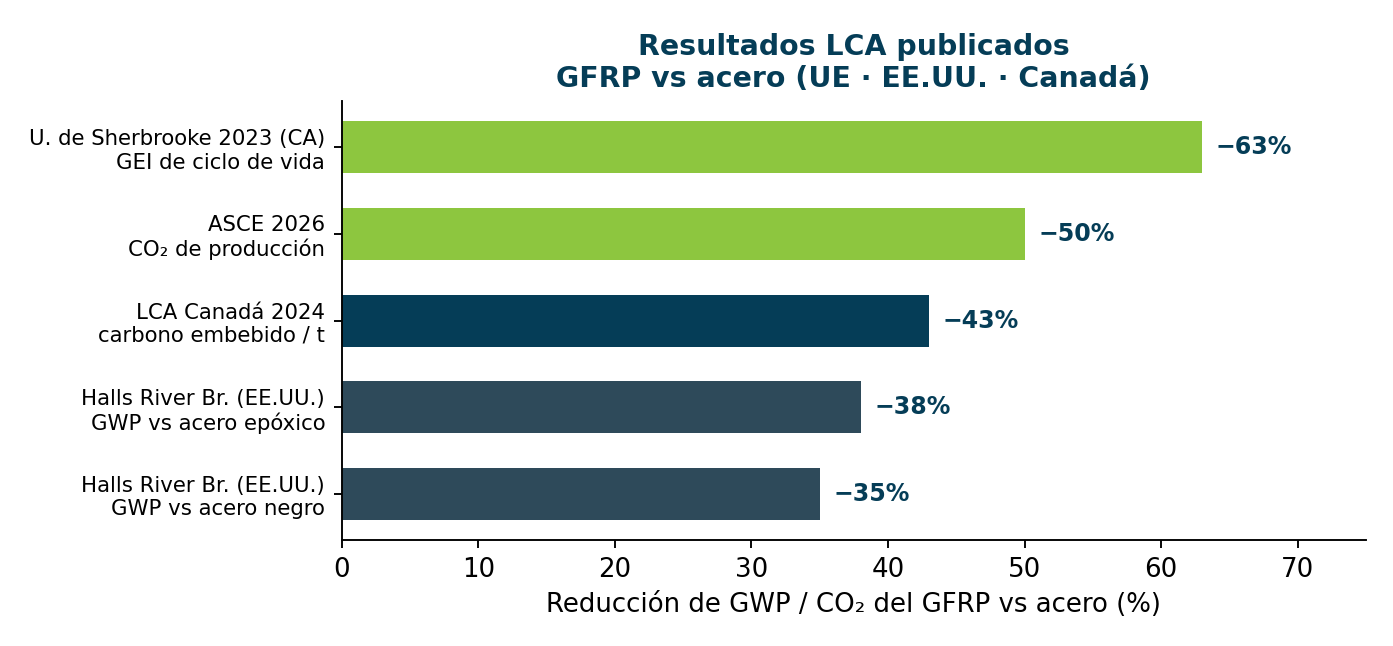
And in the EU this has stopped being a marketing argument: the Construction Products Regulation Article 15 makes climate KPIs mandatory in the Declaration of Performance starting January 8, 2026 (expanded impacts in 2030, full scope in 2032). A reinforcement with a documented 35–63% lower GWP is no longer "nice to have" — it's how the tender gets scored.
LCC: service life is the variable that matters
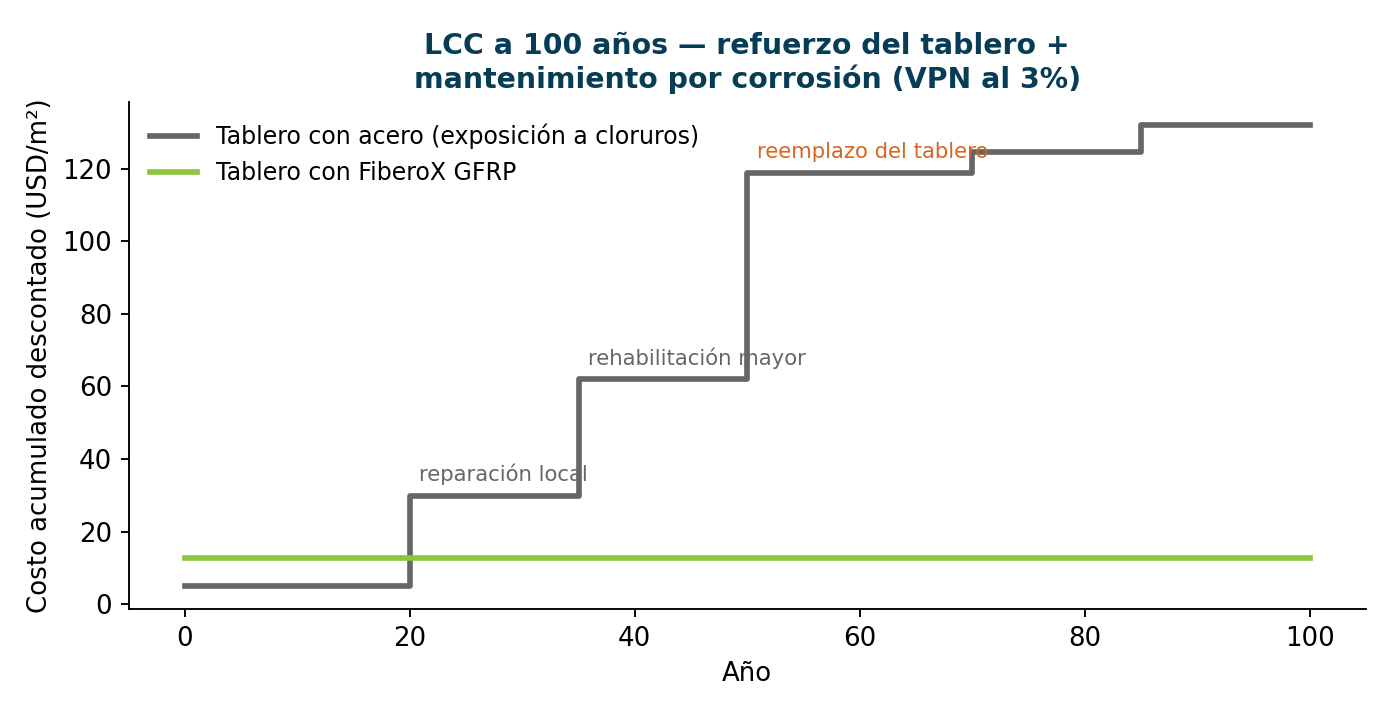
At equal diameter, GFRP costs more per meter than black steel. The right question is a different one: how much does each option cost over the life of the asset? Numeric example from our study — top mesh of a deck overlay, Ø8@150 steel vs. Ø10@150 FiberoX (the correct area for equivalent service), all discounted at a real 3%, 100-year horizon:
| Year | Intervention (steel deck) | Cost (USD/m²) | NPV at 3% (USD/m²) |
|---|---|---|---|
| 20 | Spalling repair | 45 | 24.9 |
| 35 | Major rehabilitation | 90 | 32.0 |
| 50 | Full deck replacement | 250 | 57.0 |
| 70 | Spalling repair | 45 | 5.7 |
| 85 | Major rehabilitation | 90 | 7.3 |
| — | TOTAL avoided maintenance (NPV) | — | ≈ 127 |
TCO: the cost that doesn't show up in the construction budget
The agency pays for the repair; everyone else pays for the closure. The feasibility study by Slovakia's Ministry of Transport (2025) for the renovation of 575 Class I bridges quantified the socio-economic damage of each type of intervention — passenger and freight time, fuel, vehicle wear, accident rates, emissions:
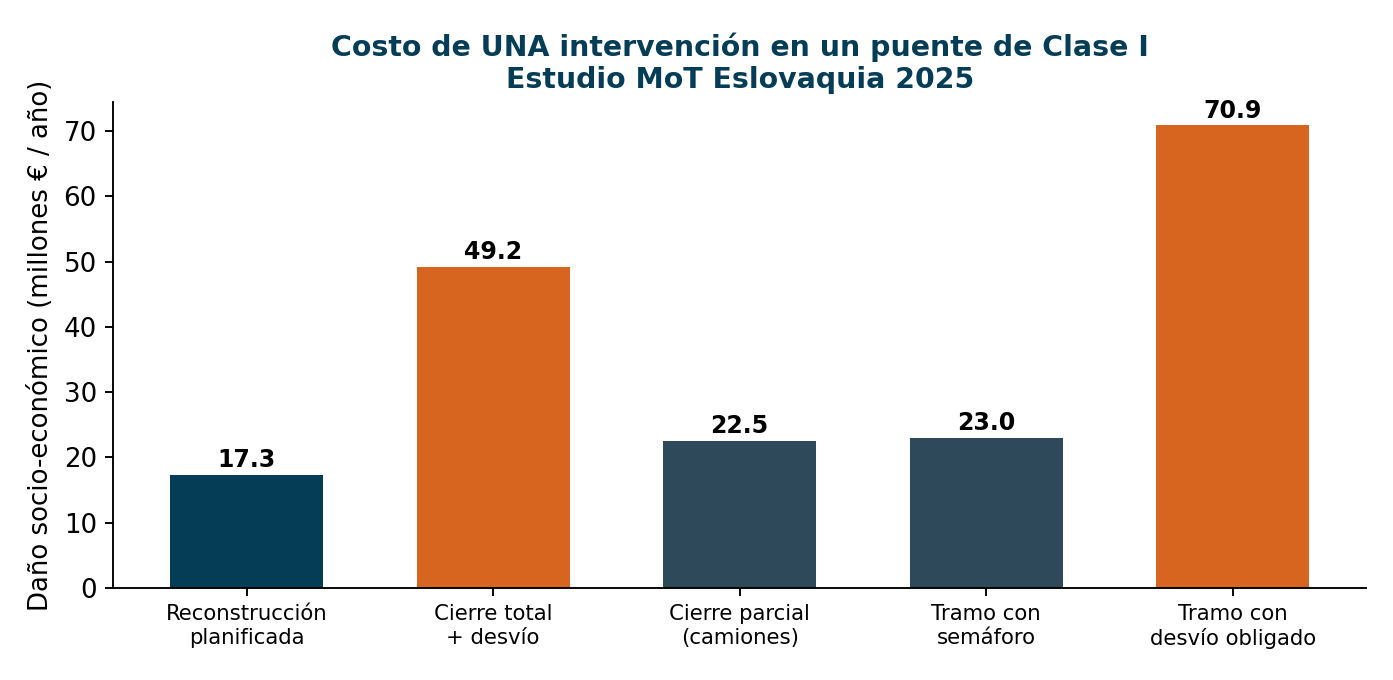
On average, one closed Class I bridge ≈ €50 million in economic damage per year; multiplied across the whole program, €28.75 billion at stake. That study's design requirements read like a GFRP spec sheet: 100-year design life, high corrosion resistance, CO₂/LCA/LCC sustainability — with "composite materials" named as the proposed solution.
Where to start: the surfaces, without touching the structure
The lowest-friction entry point requires no structural redesign: deck overlays, road panels, cornices, curbs, and barriers get replaced anyway in their normal maintenance cycle. Swapping steel mesh for FiberoX mesh in that layer needs no new structural calculation or intervention on the existing structure — and immediately eliminates the splash-zone corrosion that triggers the next closure.
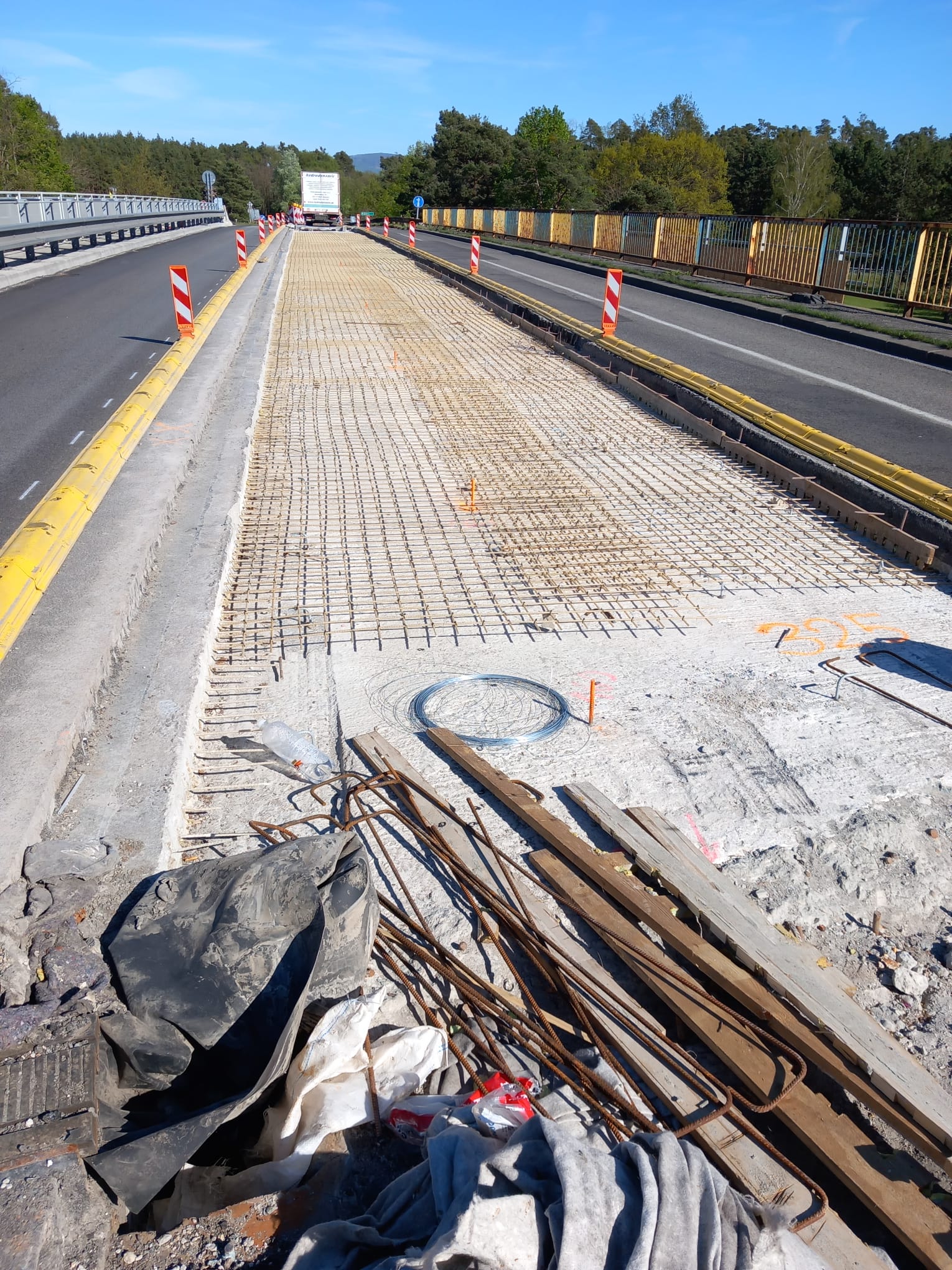
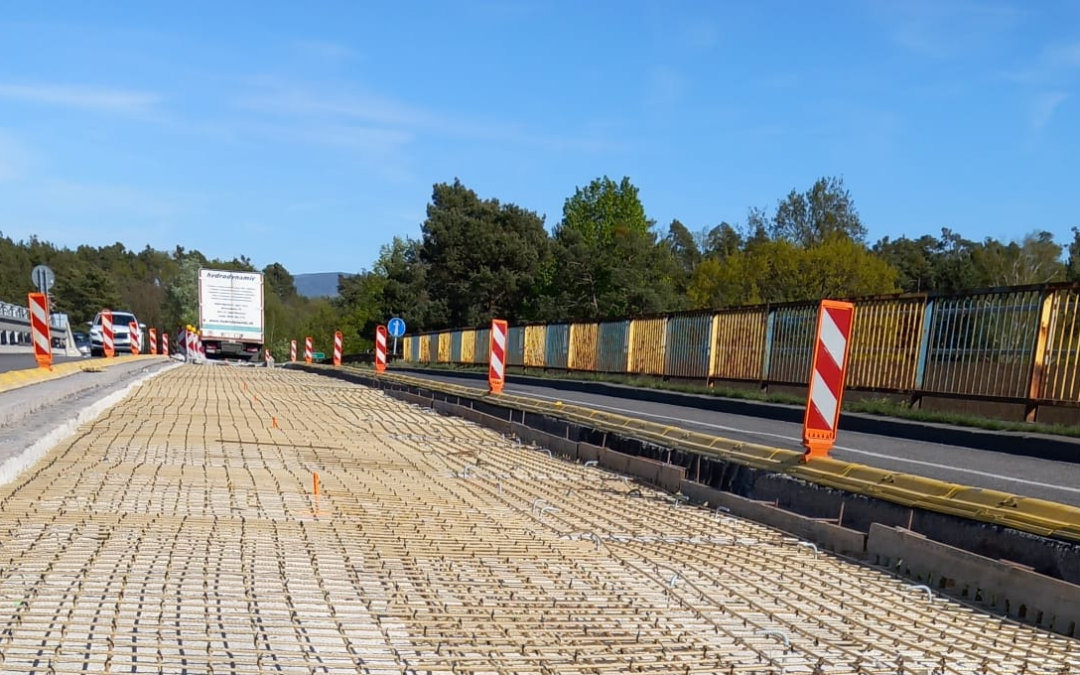
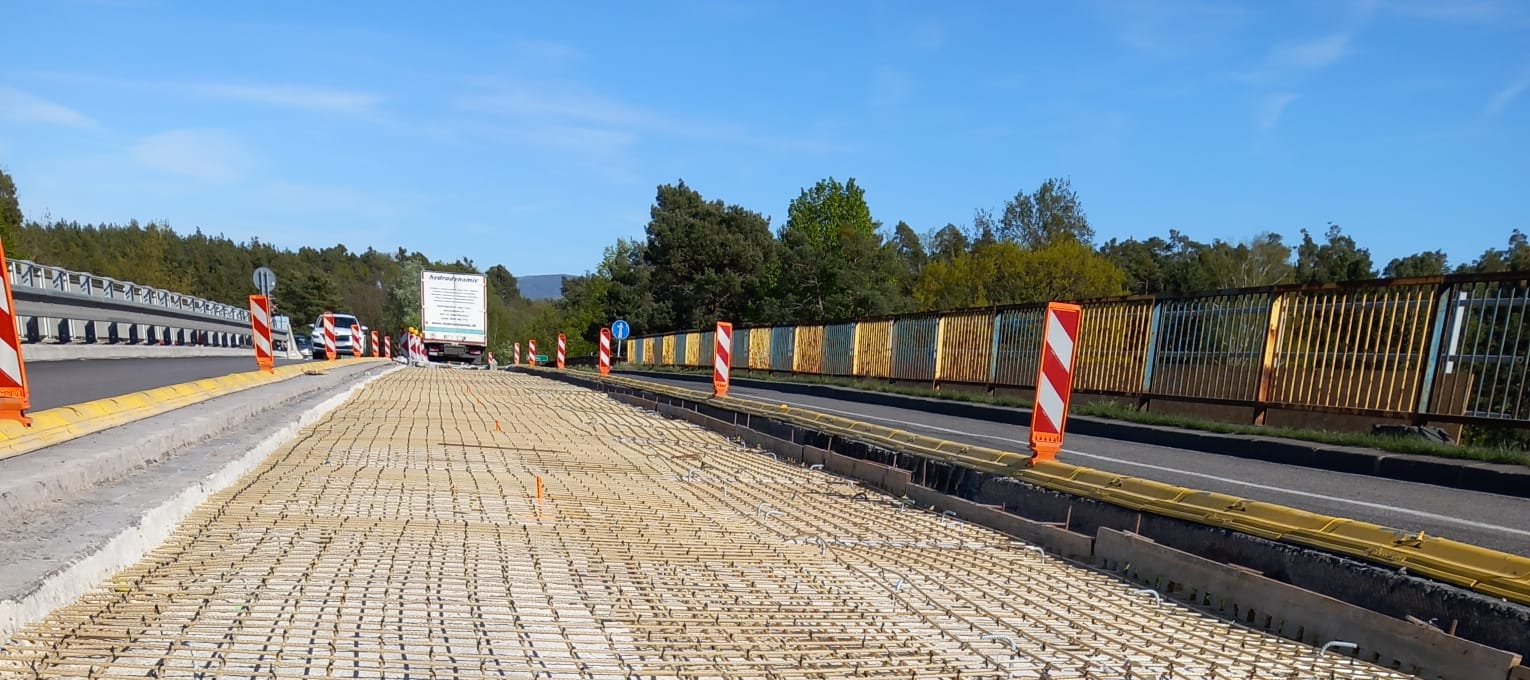
The photo comes from a Slovak highway in 2026: FiberoX mesh going in as top deck reinforcement while traffic keeps running in the adjacent lane. The manufacturer is already working through technical procedures and national standards in three EU countries — the same norm-transfer package (test protocols, acceptance criteria, design guides) that Panama can adopt. FiberoX also carries MICI R-3384-2026recognition, certified strength ≥950 MPa (SK TP-23/0023, TSÚS Bratislava) and is designed under ACI 440.11-22, the same code used by FDOT and North American agencies.
One conclusion, three metrics
- LCA: 35–63% less CO₂/GWP, documented in five studies across three continents — and legally required in the EU since 2026.
- LCC: avoided corrosion maintenance repays the initial premium ~17 times over 100 years (NPV at 3%).
- TCO: every closure avoided saves €17–71 M/year in socio-economic damage.
- Result: with FiberoX the structure lives ~100 years instead of ~30, with almost zero corrosion-related maintenance.
Do you have a bridge, road, or pavement with recurring repairs? The first step is free: tell us how much you spent repairing it over the last 10 years, and we'll give you back the LCC/TCO calculation for the GFRP alternative.
Contact
ISOThermal Innovations Inc.
📧 [email protected]
📲 WhatsApp: +507 6410-4364
🌐 isothermal.eco · isothermal.eco/fiberox
 EN
EN  ES
ES